EHR vs Paper Journal: 3 Risks That Can Erase Your Treatment History

Introduction: Two Approaches — One Goal
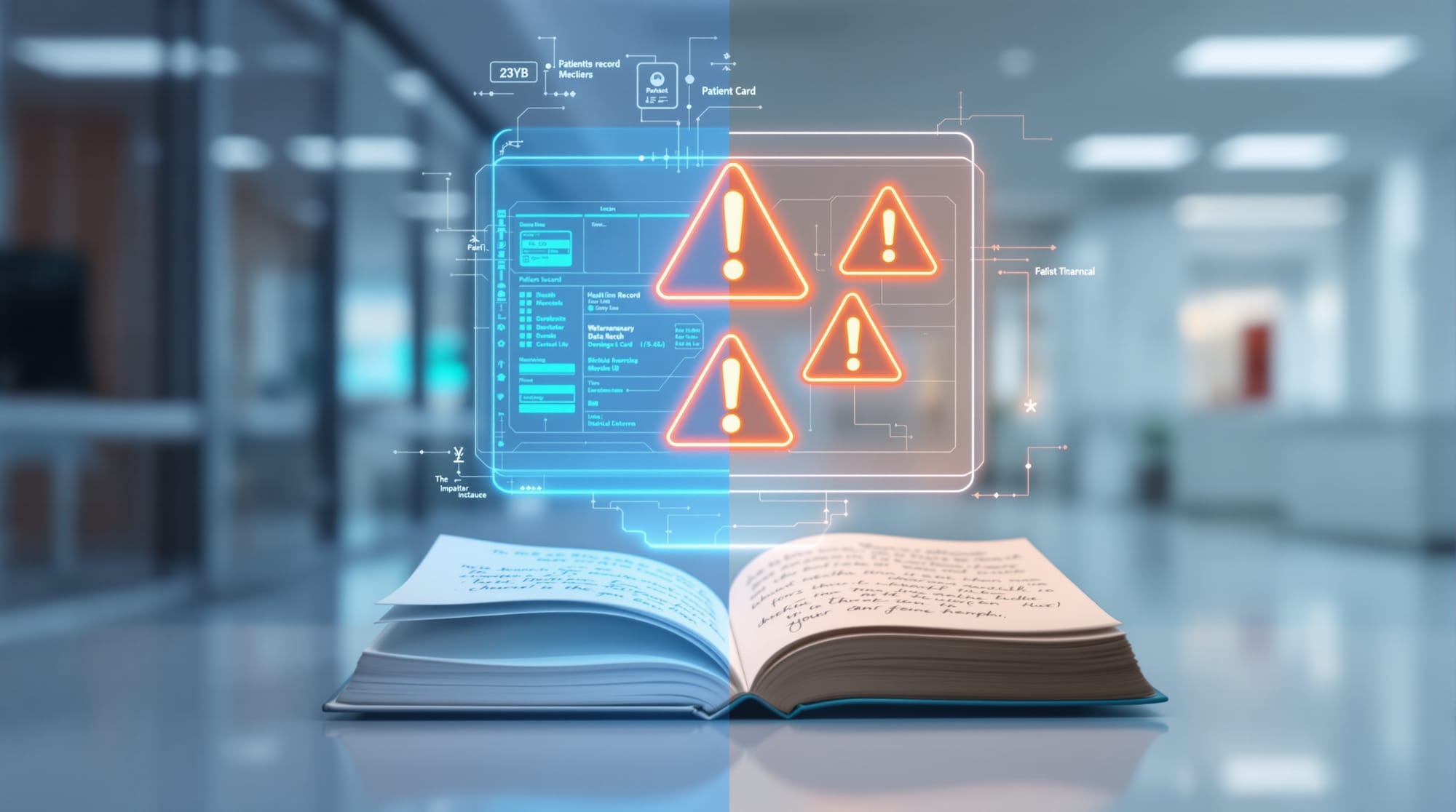
A medical record should preserve history, not create new risks. A paper journal is familiar, an EHR is convenient, but both have weaknesses.
The key question is not which is more modern, but where patient data has a better chance to survive, not get lost, and not be duplicated.
Risk 1: Data Loss
A paper journal can burn, get wet, be lost during a move, or simply disappear from an office. An EHR depends on servers, backups, and cybersecurity.
- 🔥 Paper: physical destruction, fire, water, human error.
- 💾 EHR: server failure, cyberattack, migration error.
- 🧯 Solution: backups, role-based access, and an audit log.
Conclusion: paper is lost locally, while an EHR is lost at scale. But a quality electronic system has more tools for recovery.
Risk 2: Duplicate Records
In the paper world, one patient easily turns into three records: by last name, by date of birth, by an old entry. An electronic system can also duplicate data if there is no single identifier.
- 📄 Paper: different handwriting, abbreviations, lost pages.
- 🆔 EHR: duplicates when entered without verification, different IDs, merge errors.
- 🔗 Solution: a unique ID, search by multiple fields, deduplication.
A duplicate is not just an extra record. It is a risk of prescribing a treatment that has already been given, or missing an allergy documented in another record.
Risk 3: Lack of Treatment History
Without a complete history, a doctor cannot see the dynamics: which medications worked, which caused an adverse reaction, which tests have already been completed. A paper journal is often fragmented, and an EHR may be incomplete due to different systems.
- 🩺 Paper: records from different facilities are not combined.
- ☁️ EHR: data exists, but is not always available to the doctor at the right moment.
- 📚 Solution: a single exchange standard, discharge summaries, access to key events.
Consequence: repeat tests, dangerous prescriptions, and lost time. Treatment history is not an archive, but a clinical tool.
Paper vs EHR: Which Is More Dangerous?
A paper journal risks physically disappearing and does not have quick access. An EHR risks technical failures, but can have redundancy, encryption, and an audit trail.
- ⚠️ Paper: high risk of total loss, low access control.
- ⚠️ EHR: high risk of cyber incidents, but higher manageability and recoverability.
- ✅ Hybrid approach: an electronic system as the foundation + controlled digitization of paper archives.
The worst option is neither paper nor an EHR, but a lack of system: when data is everywhere, but the complete picture is nowhere.
How to Reduce Risks in Practice
- 🔐 Implement role-based access and two-factor authentication.
- 🗂️ Maintain a single patient identifier and deduplication rules.
- ♻️ Make regular backups and test recovery.
- 📝 Record allergies, diagnoses, and prescriptions in a structured format.
- 🔍 Train staff to verify data before saving.
Conclusion
An EHR has the potential to be safer, but only with quality infrastructure, redundancy, and discipline. A paper journal is familiar, but its risks are harder to control.
Your medical data should not depend on whether you get lucky with a cabinet, a server, or a doctor's handwriting.
📬 Get in touch
Want to implement this in your business? Contact us!
- 📧 Email: info@1it.pro
- 🌐 Website: 1it.pro
- 📝 Blog: blog.1it.pro
- ✈️ Telegram Global: 1it_pro_Global
- ✈️ Telegram (UA): 1it_pro_solutions